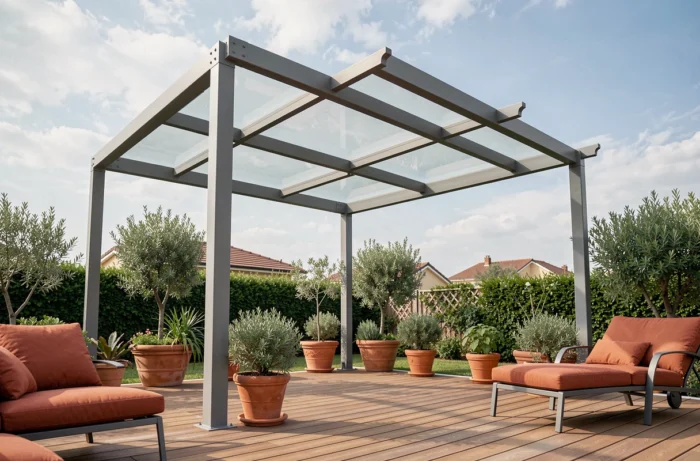
A 5×4 pergola covers approximately 20 m² of ground area, equivalent to an additional living space outdoors. At Brico Dépôt, this size is available in treated wood and aluminum, often sold as a kit. The price remains attractive compared to specialized manufacturers, but the actual durability depends on parameters rarely detailed on the product sheet: the urban planning authorization regime, the quality of the anchoring, and the type of covering chosen.
5×4 Pergola and prior declaration: the regulatory threshold to check before purchase
The 5×4 format places the project exactly on the dividing line between two urban planning regimes. Constructions creating between 5 and 20 m² of ground area are subject to a prior declaration of works. Beyond 20 m², a building permit becomes mandatory.
The nuance lies in the area where the plot is located. In urban areas covered by a PLU, the threshold for the prior declaration can rise to 40 m² for an extension attached to the dwelling. A freestanding pergola installed at the back of the garden does not benefit from this tolerance.
Another often overlooked point: pergolas presented as “removable” are only truly exempt from formalities under very restrictive conditions. The structure must not remain in place for more than three months a year, and it must not have any permanent anchoring to the ground. A Brico Dépôt kit fixed on bolted plates in a concrete slab does not fall into this category, even if the box mentions “removable”.
Before ordering, a visit to the town hall or a consultation of the local PLU can help avoid a demolition order. To delve deeper into the question of longevity and structure choice, a guide details how to choose a 5×4 Brico Dépôt pergola based on real technical constraints.

Polycarbonate, fabric or adjustable slats: how the choice of roofing changes things
The supporting structure represents only half of the issue. The type of covering determines both the comfort of use and the durability over time.
Polycarbonate: rigid but sensitive to UV
Honeycomb polycarbonate sheets offer good light transmission and resist impacts. However, without UV treatment on both sides, they yellow and become brittle within a few seasons. Large retail kits often offer sheets treated on only one side.
Polycarbonate is suitable for rainy regions where permanent protection is sought. It transforms the pergola into a nearly open veranda, with a greenhouse effect in summer that needs to be anticipated.
Retractable fabric: flexibility of use, regular maintenance
A waterproof fabric mounted on a roller or tracks allows for shading to be adjusted according to the season. The downside is regular maintenance: an uncleaned fabric develops mold that weakens the material in less than two years. The weight must be dense enough to withstand wind without tearing.
Adjustable slats: the bioclimatic format
Bioclimatic pergolas with adjustable aluminum slats represent the high-end range. The slats pivot to regulate ventilation and light. This format is rarely available as a kit at Brico Dépôt in the 5×4 dimension, but the brand’s custom configurator allows access to it.
The additional cost compared to a wooden structure with fabric is significant. The question to resolve is that of actual use: a pergola used only in summer does not justify the same investment as an outdoor space occupied nine months a year.
Aluminum or wood pergola in a kit: decide based on the terrain and exposure
The choice of material is not just an aesthetic preference. It affects the long-term durability of the structure.
- Aluminum does not rust, does not deform under humidity, and requires no periodic treatment. It is suitable for wind-exposed areas or those located by the sea, where salt corrosion quickly attacks wood and steel.
- Treated autoclave wood (usually pine) offers a natural appearance and a lower price. A minimum use class 3 is required for outdoor use without permanent contact with the ground. Class 4 is necessary if the posts rest on a damp slab or poorly drained ground.
- Wood kits require a stain or saturator every two to three years to maintain protection. Without this maintenance, the wood grays and then structurally deteriorates.
- Aluminum better supports large spans without an intermediate post, freeing up space under the pergola for terrace layout.
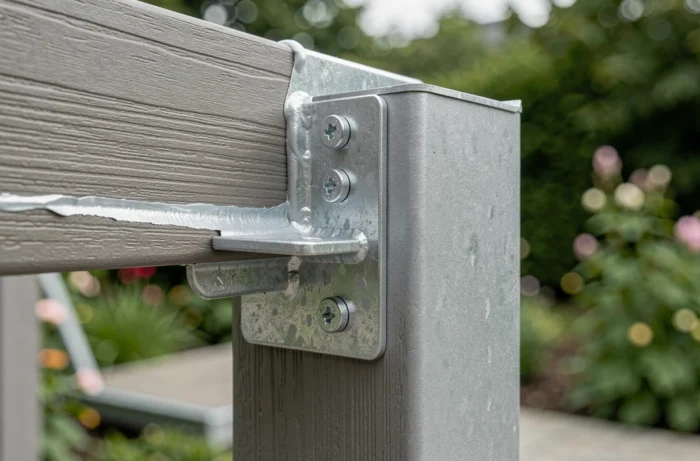
On soft or sloped ground, the anchoring to the ground conditions stability as much as the material. Posts on bolted plates in concrete footings provide reliable anchoring for both materials. Kits delivered with simple stakes to drive in do not withstand the first serious gusts.
5×4 Attached or freestanding pergola: technical and tax implications
An attached pergola leans against the load-bearing wall of the house. This configuration reduces the number of posts needed and simplifies bracing. It also creates a structural link with the existing building, which can modify the taxable area of the dwelling according to the interpretation of the local tax service.
A freestanding pergola, placed away from the house, remains legally an independent construction. It does not affect the floor area of the main building as long as it does not have permanent side closures. As soon as fixed walls or integrated vertical blinds are added, the administration may reclassify the structure.
At Brico Dépôt, attached models dominate the wooden range, while freestanding pergolas are more common in aluminum. The choice between the two depends on the terrace configuration, orientation to the sun, and whether or not to integrate the pergola into the declared building.
The 5×4 format remains a moderate investment compared to closed verandas, but its longevity depends more on the project’s preparation than on the price paid in-store. Checking the urban planning regime, choosing a suitable use class for the terrain, and planning a regular maintenance budget are the three parameters that separate a pergola still standing after ten years from a structure dismantled after four.