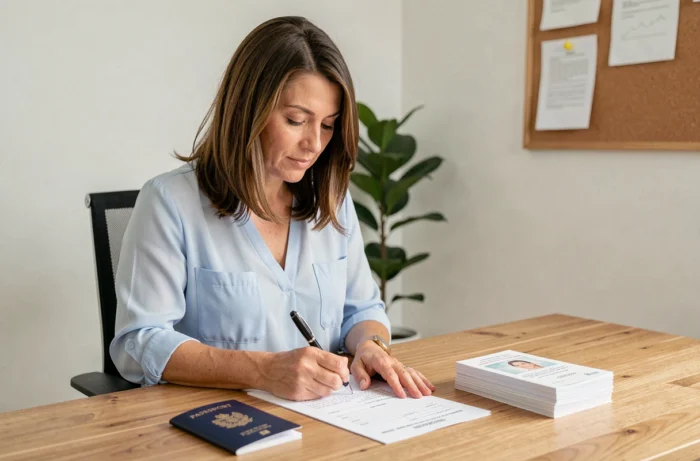
Renewing a French passport requires a mandatory visit to the town hall, regardless of the level of digital preparation of the application. The online pre-application on the ANTS website speeds up the preparation of the file, but does not eliminate the need for a physical appointment. Understanding where the real time-saving levers are, between document preparation, the choice of submission location, and emergency cases, helps avoid weeks of waiting that can block a travel project.
ANTS Pre-Application and Town Hall Appointment: Where the Delay Really Lies
The most common confusion concerns the exact role of the online pre-application. Filling out the form on the ANTS website generates a file number and allows for the purchase of a dematerialized tax stamp. This step reduces the time spent at the counter, but the appointment at the town hall remains mandatory to submit the file.
The real bottleneck is therefore in the availability of appointment slots. Many town halls require a prior appointment, and the waiting times vary greatly from one municipality to another. A rural town hall may offer an appointment slot within a few days, while some large cities may show several weeks of waiting.
Those looking to extend a passport quickly with Sortie 24 will find a summary of tips to shorten this process. The basic principle remains the same: the submission location is not tied to the place of residence. You can submit your file at any town hall equipped with a registration station, anywhere in France.
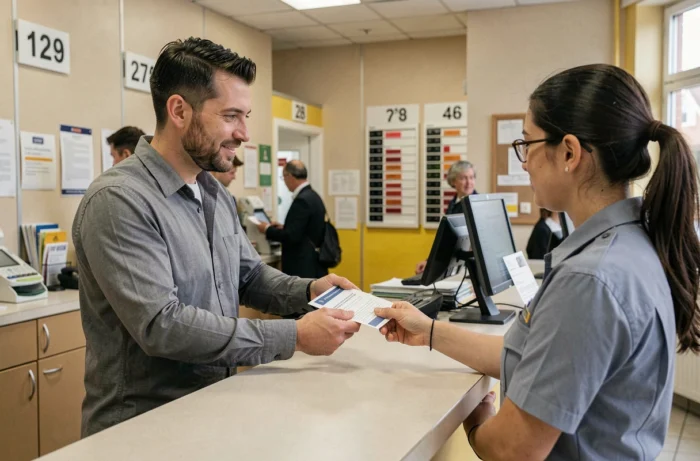
Comparison of Delays Based on Application Method and Submission Location
The total delay between submitting the file and receiving the passport depends on several factors. The table below summarizes the variables that concretely influence the duration.
| Variable | Impact on Delay | Applicant’s Leverage |
|---|---|---|
| Completed ANTS Pre-Application | Reduces time at the counter | High: accessible to everyone online |
| Choice of Town Hall | Determines the delay in obtaining an appointment | High: no obligation for geographical proximity |
| Time of Year | Peaks in applications before summer vacations | Medium: anticipate several months in advance |
| Complete File on First Visit | Avoids a second appointment | High: check each document in advance |
| Manufacturing by the National Printing Office | Incompressible delay after validation | None: no leverage on the user’s side |
The key takeaway: the manufacturing delay is fixed, but the delay in accessing the appointment is variable. It is on this second component that the scope for action is the widest.
Emergency Passport: Real Conditions and Limits
The emergency passport is not a comfort accelerator. It is reserved for specific situations: justified medical, humanitarian, or professional reasons. A simple tourist departure is not sufficient to trigger the procedure.
Several administrative sources confirm that issuance can occur within a few days in acceptable cases. However, an incomplete file blocks the emergency procedure just as much as a standard application. Urgency never compensates for a missing document.
- The applicant must provide proof of the emergency reason (professional summons, medical certificate, document attesting to a humanitarian situation).
- The application is made at the prefecture or sub-prefecture, not at a regular town hall.
- The emergency passport issued may have a shorter validity period compared to the standard biometric passport.
User testimonials on the Services Publics + platform illustrate possible disappointments. A renewal presented as feasible in one month can exceed that timeframe without the administration providing clear visibility. The emergency passport does not make up for insufficient anticipation.
Renewal from Abroad: A Distinct, Little-Documented Process
French citizens residing abroad have a specific channel for renewal, via consulates. In some cases, renewal can be done without traveling to the consulate, provided all the following conditions are met:
- The passport is still in the applicant’s possession.
- The applicant was an adult when the current passport was issued.
- The validity of the passport is still ongoing or has expired for less than five years.
- No change of name, first name, or gender has occurred since the last issuance.
This system significantly simplifies the process for expatriates who meet these criteria. However, any change in civil status requires a physical visit to the consulate, with the delays that this entails depending on the geographical area.

Renewal File: Documents That Cause Rejection
The list of required documents is public and stable. The current passport (even if expired), a compliant identity photo, proof of residence, and the tax stamp constitute the foundation. The non-compliant photo remains the primary cause of rejection at the counter.
The standards require a plain light background, a clear face, a neutral expression, and precise framing. Approved automatic photo booths reduce this risk, but a photo taken in a non-certified studio may be refused without immediate recourse.
Another point of friction: proof of residence. A document older than twelve months or proof in the name of a third party without a housing certificate will systematically lead to a return to the counter. Each rejected document means a new appointment, resulting in several additional days or weeks of delay.
Renewing a passport does not extend it in the strict sense: a new title is obtained. The speed of the process depends less on manufacturing than on the rigor of the file and the strategic choice of the town hall. Checking each document before the appointment, broadening the search for slots beyond one’s municipality, and anticipating peak demand periods remain the three concrete levers to act upon.