Industrial maintenance in 2026 is played out on a regulatory and technological terrain that most traditional maintenance plans do not cover. We are heading straight to the points that will significantly change the game for maintenance managers and operations directors.
New European Machinery Regulation: What Changes for Maintenance Starting January 2027
Any substantial modification of equipment, whether mechanical or software-related, will be legally considered as manufacturing from January 20, 2027. The new Machinery Regulation completely replaces Directive 2006/42/EC without a coexistence period.
For maintenance teams, the consequence is direct: modifying a machine to correct a recurring defect or integrating a new sensor can shift the company into a manufacturer role, with the resulting obligations for CE marking, risk analysis, and technical documentation.
The technical documentation must be kept for at least ten years after the product is placed on the market. Maintenance instructions can be entirely digital, but a free paper copy must be provided within a month if the user requests it at the time of purchase.
We recommend mapping every maintenance intervention that affects the design or embedded software of equipment right now. A simple like-for-like component replacement remains a maintenance operation. However, a modification that creates a new hazard or increases an existing risk triggers manufacturer obligations. The boundary between the two merits an internal audit before the regulation comes into effect.
A detailed article on industrial maintenance on Airbuzz discusses the operational constraints related to this regulatory timeline.

Cybersecurity of Connected Maintenance Systems: A Compliance Requirement
IoT sensors, SaaS CMMS platforms, and digital twins multiply attack surfaces. In 2026, cybersecurity is no longer a peripheral IT issue for maintenance: it becomes a compliance requirement integrated into the European regulatory framework. The digital components embedded in equipment must meet security criteria from the design stage.
In practical terms, this requires maintenance teams to collaborate with IT security managers on several points:
- Every software update of a controller or supervisory system must be tracked and assessed as a potential modification under the regulation.
- Remote access to equipment (remote maintenance, remote diagnostics) requires strict network segmentation and enhanced authentication protocols.
- Maintenance data collected by IoT sensors must be protected against any alteration that could distort predictive alert thresholds.
We observe that many industrial sites have deployed connected sensors without an update policy or network segmentation. A compromised sensor can generate false alerts or mask a real drift, negating all the benefits of a predictive strategy.
Predictive Maintenance and Zero Unplanned Downtime: Going Beyond Marketing Talk
Predictive maintenance relies on the analysis of vibrational, thermal, or consumption data to anticipate failures. The principle is known. What is less understood is the level of maturity actually required to achieve a zero unplanned downtime goal.
A predictive model is only reliable if it is trained on a failure history specific to the equipment concerned. Applying a generic algorithm to a production line without specific training data produces false positives that overwhelm teams and false negatives that allow critical failures to slip through.
Calibrating Alert Thresholds by Equipment
The temptation is to set wide alert thresholds to “not miss anything.” The result: an inflation of unnecessary preventive interventions that consume resources and generate risks themselves (human error during reassembly, introduction of contaminants). We recommend defining thresholds based on an updated FMEA analysis, cross-referenced with actual sensor data over a minimum period of several months.
Integrating CMMS into Production Management
The real lever to avoid production stoppages lies in the coupling between CMMS and the management system (MES or ERP). When a predictive alert is raised, the planning tool must be able to automatically recalculate the scheduling to fit the intervention into a lower-impact slot. Without this integration, predictive maintenance remains a diagnostic tool, not a tool for production continuity.
Traceability of Interventions and Document Retention: Anticipating Audits
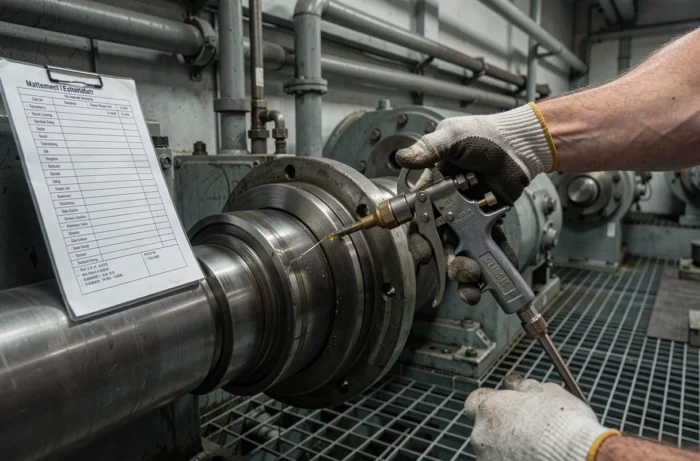
The traceability of maintenance interventions goes beyond simple good organizational practice. With the new European regulatory framework, any intervention that modifies the characteristics of equipment must be documented in a way that proves it does not constitute a substantial modification, or to assume the obligations that arise if it does.
An effective traceability system relies on three pillars:
- The time-stamped recording of each intervention with identification of the operator, replaced parts, and modified parameters.
- The retention of risk analysis reports associated with modifications, even minor ones, for the lifetime of the equipment.
- The ability to produce a complete history in case of an audit or accident, including the sensor data that triggered the intervention.
CMMS must archive maintenance data for at least ten years to remain aligned with regulatory requirements. SaaS solutions must contractually guarantee this retention period, including in the event of a change of provider.
The period separating industrial sites from January 2027 is short. Auditing existing interventions, validating predictive models, and securing connected systems represents foundational work that cannot be caught up in a few weeks. Teams that tackle this now will gain a lasting operational advantage over those who wait for the deadline.