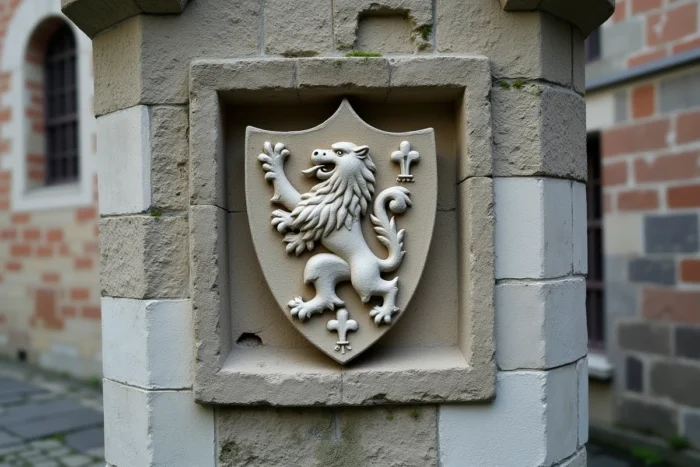
Have you ever noticed this white flower on a red background, displayed on the official buildings of Lille, sports jerseys, or street signs? This symbol is the coat of arms of the city. A silver fleur-de-lis placed on a shield of gules (bright red, in heraldic language). Behind this simple image lies a tumultuous political history, far richer than just a municipal logo.
The marsh iris of the Deûle, forgotten ancestor of the Lille coat of arms
Before discussing royalty or politics, one must look at the ground. Lille derives its name from “L’Isle,” an ancient term that refers to its original location near a marshy area of the Deûle. The city literally rises from the water.
The fleur-de-lis depicted on the coat of arms is not just a monarchical emblem. In the local interpretation, it also evokes the water iris of the marshes that surrounded the city. This link between heraldry and geography gives the coat of arms a dual reading: it speaks of both the physical territory and political allegiance.
The first written evidence of Lille’s existence dates back to a charter from 1066, by which Baldwin V, Count of Flanders, endowed the collegiate church of Saint-Pierre. The city is then referred to as “isla,” from the Latin “insula.” When one understands this relationship to water, the history of the Lille coat of arms takes on a geographical dimension that is often overlooked in favor of the dynastic narrative.

The Lille coat of arms between medieval memory and Napoleonic appropriation
The coat of arms has traversed the centuries, changing hands but not design. The silver fleur-de-lis on a red background accompanies Lille through its Flemish, Burgundian, and then Spanish periods. Each power retains the symbol, as it legitimizes the continuity of the city itself.
The turning point comes with Louis XIV’s conquest in 1667. Lille becomes French, and the fleur-de-lis then takes on an additional connotation: that of attachment to the Kingdom of France. The same motif changes political meaning without changing form.
The imperial arms of 1811
Under Napoleon I, the logic is quite different. In 1811, the city receives imperial arms that replace the traditional coat of arms. This is no longer an adaptation; it is a substitution. The Napoleonic power imposes its own heraldic codes on the cities of the Empire, temporarily erasing local symbols.
This interlude illustrates a recurring mechanism: the coat of arms serves as a ground for asserting central power. When a regime wants to mark its dominance over a city, it alters its heraldry. The symbol is not decorative; it is political.
Republican reaffirmation of the coat of arms in the 20th century
After the fall of the Empire, the original coat of arms gradually returns. The definitive restoration takes time. It is in 1901 that Mayor Gustave Delory initiates an official rehabilitation of the medieval coat of arms, turning the page on the imperial arms assigned under Napoleon I.
Why wait almost a century? Because the question of the coat of arms is never purely aesthetic. Under the Third Republic, restoring the fleur-de-lis might have seemed paradoxical: this motif evoked monarchy for many French people. In Lille, the reading was different. The silver fleur-de-lis on gules primarily represented the identity of the city, not that of a king.
The design of 1926, current version of the coat of arms
The current design of the coat of arms dates back to 1926. This detail matters: the emblem we see today is not a frozen relic of the Middle Ages. It has been redrawn, standardized, and adapted to the administrative uses of the 20th century.
This process of graphic modernization, while retaining the original heraldic elements (gules and silver fleur-de-lis), shows how a city can reconcile medieval heritage and republican identity. The Lille coat of arms has become a local marker, disconnected from royalist symbolism.

Reading the Lille coat of arms: heraldic vocabulary and key elements
In heraldry, the coat of arms of Lille is described by a precise formula: “De gueules à une fleur de lys d’argent.” Each word has a technical meaning.
- “De gueules” refers to the red background of the shield, a color traditionally associated with courage and warrior nobility.
- “Fleur de lys d’argent” indicates a white motif (silver in heraldry corresponds to white), of the “florencée” type, meaning with open petals, distinct from the classic royal lily.
- The absence of external ornamentation (crown, animal supporters) in the historical version reinforces the characteristic sobriety of the Lille coat of arms, contrasting with the more elaborate coats of arms of other major French cities.
This simplicity is not a lack. It reflects an identity built around a single strong motif, instantly recognizable. While other cities accumulate lions, towers, and mottos, Lille relies on a unique symbol.
The coat of arms in the Lille landscape today
You will encounter the coat of arms everywhere in the city: on the facade of the town hall, engraved in the stone of the Porte de Paris (the triumphal arch erected to celebrate Louis XIV’s conquest), on administrative documents, and even on tourist merchandise.
Its use goes beyond the institutional framework. Sports clubs draw inspiration from it, local businesses integrate it into their visual identity, and it regularly appears in Lille street art. The coat of arms functions like a city logo before its time, a rallying sign that transcends historical divides between Flanders, France, and northern identity.
- Town hall and municipal buildings: official use on documents and signage.
- Porte de Paris: the sculpted coat of arms recalls the attachment to France under Louis XIV.
- Cultural and sporting life: reappropriation by the people of Lille as a marker of local belonging.
The coat of arms of Lille has survived the Counts of Flanders, the Dukes of Burgundy, the Spanish crown, Louis XIV, Napoleon I, and three republics. Its longevity lies in a paradox: a motif simple enough to be appropriated by all powers, and deeply rooted in the territory so that the people of Lille have never abandoned it.