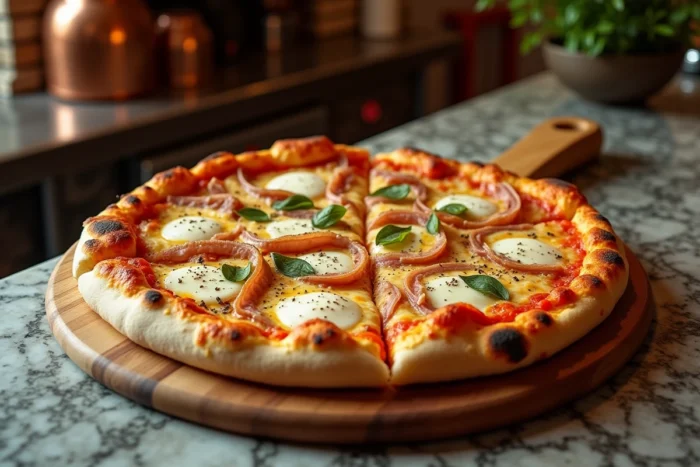
The carbonara pizza from Del Arte transposes the codes of a Roman recipe onto a pizza dough base. The result raises a question that goes beyond simple gustatory pleasure: where does this pizza stand between traditional Italian carbonara and the creamy adaptations typical of French chain restaurants? Comparing the ingredients and approaches allows for a better understanding of what we are actually eating.
Roman carbonara and pizzeria carbonara: ingredients face to face
The carbonara as codified in Rome relies on a short and non-negotiable list of ingredients. The versions adapted by French restaurant chains deviate from this in several ways. The table below compares the two approaches.
| Component | Traditional Roman carbonara | Carbonara pizza version (French chains) |
|---|---|---|
| Fat base | Guanciale (dried pork cheek) | Bacon bits, bacon, or ham |
| Cheese | Exclusively Pecorino Romano | mozzarella, parmesan, or a blend |
| Binder | Emulsified egg yolks | Fresh cream or mascarpone |
| Added fat | None (the guanciale is sufficient) | Cream as a sauce base |
| Pepper | Coarsely cracked black pepper, generously | Often absent or subtle |
The most visible difference concerns the absence of cream in the original Roman recipe. Italian specialists and culinary reference sites all emphasize this point: the creamy texture comes solely from the emulsion of egg yolks, pecorino, and pasta cooking water.
At Del Arte, Del Arte’s carbonara dough embraces a creamy base on which a runny egg provides a visual and gustatory reminder of the original recipe. The choice is deliberate, but it places this pizza on the side of French adaptations, not strict Roman tradition.
Del Arte carbonara pizza: how the creamy base changes the taste
Replacing the emulsion of eggs and pecorino with cream profoundly alters the dish’s flavor profile. The cream softens and unifies the flavors, whereas the pecorino provides a bold saltiness and the guanciale offers a melting fat with slightly smoky notes.
On a pizza, this difference is amplified by the oven cooking. The cream, exposed to high heat, tends to solidify and lose its creaminess. The runny egg placed on top partially compensates for this effect by creating a natural sauce at the moment the diner breaks it.

The final result also depends on the chosen charcuterie. Bacon bits or bacon, more common in chain restaurants, deliver a pronounced smoky flavor that masks the nuances of the cheese. In contrast, the guanciale used in the Roman recipe almost entirely melts during cooking and releases a silky fat, without any intrusive smoky notes.
For the consumer ordering a carbonara pizza at Del Arte, the pleasure thus lies in a different realm than that of a plate of spaghetti carbonara served in a Roman trattoria. The two experiences are not comparable in terms of taste, even if they share a name.
Guanciale and pecorino in France: a game-changing availability
In recent years, guanciale and Pecorino Romano have gained visibility in gourmet shops and the Italian sections of large French supermarkets. This rise is accompanied by a growing public awareness of the authentic recipe, fueled by culinary blogs and Italian cooking videos.
- Guanciale can now be found in most Italian grocery stores and in some supermarkets, whereas it was relatively unknown about ten years ago.
- Pecorino Romano, a hard sheep’s milk cheese from Lazio, is increasingly distinguished from parmesan by discerning consumers.
- Online content describing the “real” Roman carbonara has multiplied, creating an expectation of transparency among restaurant customers.
This evolution places chains like Del Arte in a strategic position. They can either clearly claim a French reinterpretation of carbonara, or they can attempt to move closer to the traditional recipe, which would require revising their sourcing of charcuterie and cheese.
Why most chains keep the cream
The cost of guanciale remains significantly higher than that of industrial bacon bits. Pecorino Romano also costs more than generic parmesan or mozzarella used as a pizza base. For a chain serving several hundred covers per day across all its restaurants, the difference in material costs impacts margins.
Cream also offers an operational advantage: it is easy to measure, stores well, and produces a consistent result from one restaurant to another. The egg-pecorino emulsion requires precise technical skill and does not tolerate temperature errors well. Transposing this technique onto a pizza cooked at high temperatures adds an additional constraint.
Italian flavors in chains: what Del Arte’s carbonara pizza says about the French market
The Del Arte carbonara pizza illustrates a broader trend in French dining. The names of classic Italian dishes (carbonara, pesto, arrabiata) serve as reference points for consumers, but the recipes are systematically adapted to local habits and production constraints.
This adaptation is not unique to Del Arte. The majority of French pizzeria chains offer creamy versions of carbonara. The phenomenon reflects a lasting cultural gap between Italian cuisine as practiced in Italy and its translation in French commercial dining.
For those seeking an explosion of Italian flavors in the strict sense, Del Arte’s carbonara pizza offers a delicious and accessible dish, with a runny egg that adds a touch of character. The pleasure is real, but it falls under a French interpretation rather than a fidelity to the Roman recipe. Knowing this distinction allows for informed ordering and appreciation of each version for what it truly brings.