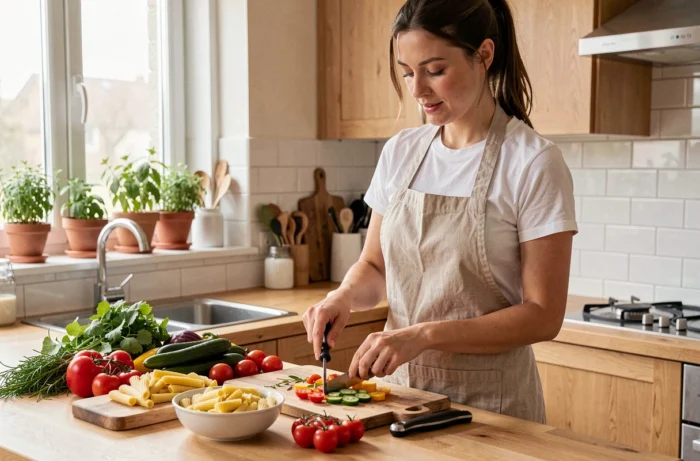
Knowing what to eat each day is less about a lack of recipes and more about a method issue. Search engines are overflowing with lists of dishes, but the real blockage is upstream: how to structure meals so that the question doesn’t come up every evening at 6 PM. Several recent approaches favor a modular logic and partial preparation rather than the constant search for new easy and quick meal ideas.
Modular meals: proteins, vegetables, starches as a daily base
The meal kit trend is based on a simple principle: instead of following a complete recipe, you assemble three blocks. A source of protein (chicken, salmon, eggs, legumes), a seasonal vegetable, a whole grain (rice, pasta, quinoa). This breakdown reduces mental load because it transforms the question “what to eat” into three micro-decisions.
In practice, with about ten proteins, ten vegetables, and five starches in rotation, you can create hundreds of combinations without ever opening a cookbook. Monday’s salmon with broccoli and rice becomes Thursday’s salmon with zucchini and pasta. Variety comes from combinations, not recipes.
This approach works particularly well for lunch at the office, where preparation time is limited and one seeks a balanced meal without complexity. Platforms like keskejmets.fr facilitate this logic by offering structured ideas around everyday ingredients rather than isolated recipes.
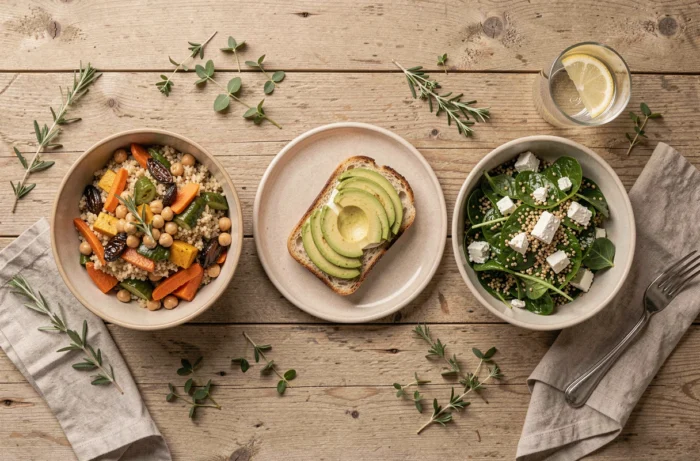
Light batch cooking: preparing without dedicating the entire Sunday
Classic batch cooking, which takes up an entire Sunday afternoon, is as discouraging as it is appealing. Feedback on this point varies: some households keep up the pace, while many give up after a few weeks. A lighter version is gaining ground, focused on partial preparation rather than full cooking.
Preparing certain ingredients in advance changes the game. Washing and chopping vegetables, cooking a large quantity of rice or pasta, preparing a versatile sauce. The rest comes together at mealtime in just a few minutes. This method requires about thirty minutes spread over two evenings rather than a three-hour block on the weekend.
What can be prepared well in advance
- Starches (rice, quinoa, lentils) keep for several days in the refrigerator and can be reheated in a pan or oven in a few minutes
- Homemade sauces (basil tomato sauce, lemon-mustard vinaigrette, light cheese sauce) transform a bland dish into a tasty meal without extra effort on the same day
- Washed, peeled, and chopped vegetables in airtight containers: this is the chore that most hinders daily cooking, and it can be done very well while watching an episode of a series
Cooking in double batches remains the most cost-effective gesture. A casserole from Tuesday night provides lunch for Wednesday. A roasted chicken from Sunday serves as the base for salad, wrap, or sandwich for two days.
Quick anti-waste meals: cooking with what’s left in the fridge
The reflex to search for a recipe before checking what you already have creates a vicious circle: unnecessary shopping, forgotten food at the back of the vegetable drawer, regular waste. Reversing the logic, starting with leftovers to build the meal solves both problems at once.
A mix of various vegetables gives you a stir-fry, a casserole, or a soup depending on the season. Leftover chicken transforms into a composed salad with feta and lemon, or as a filling for an express wrap. Leftover pasta, sautéed with an egg and soy sauce, becomes a complete dish.
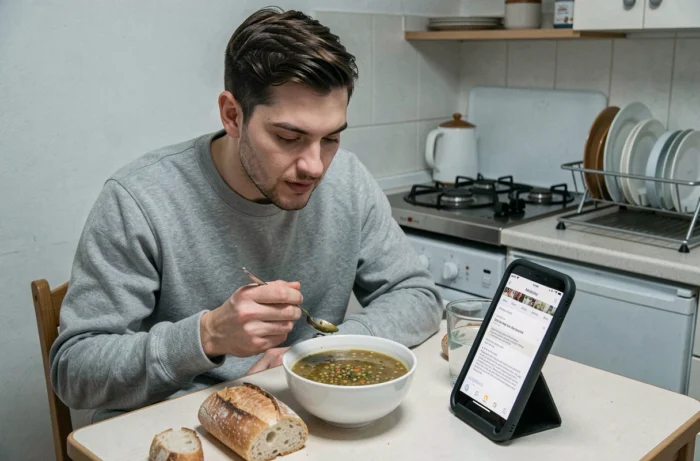
Three reflexes to stop throwing away
- Check the contents of the refrigerator before planning meals for the week, not after shopping
- Always keep a few versatile ingredients in the pantry (eggs, grated cheese, tomato sauce, mustard) that can save any leftover
- Freeze excess portions on the same day rather than letting them go to waste over the week
Anti-waste is not an abstract ecological gesture; it’s a direct financial gain. A household that throws away less buys less, and the question “what to eat tonight” finds its answer in the fridge rather than on the internet.
Planning weekly meals without falling into rigidity
Menu planning suffers from a rigid image: a fixed chart stuck on the fridge that you end up ignoring by Wednesday. In contrast, flexible planning, which sets the proteins for each day without locking in the sides, lasts longer.
Setting five proteins on Sunday night is enough to defuse the daily question. Monday chicken, Tuesday eggs, Wednesday fish, Thursday legumes, Friday improvisation with leftovers. The vegetables and starches adapt to what you find, your mood, and the time available.
This method also avoids the trap of repetition. Recipes rotate naturally because the framework remains stable while the content varies. A baked salmon with lemon one week becomes a salmon en papillote with vegetables the next, without reinventing the menu each time.
The real barrier to easy and quick meals is not a lack of ideas. It’s the absence of a minimal structure that forces you to decide each evening from scratch. A light framework frees up more creativity than a constant search for new recipes. A few planned proteins, ready-to-use vegetables, a pantry stocked with basics: everyday cooking becomes a fluid assembly rather than a renewed chore.