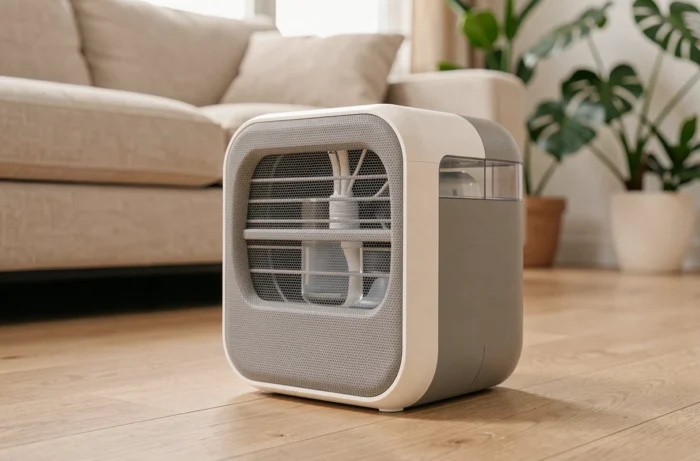
An air cooler relies on a simple physical principle, evaporative cooling, but its actual effectiveness depends on parameters that product specifications rarely detail. Ambient temperature, room humidity, air flow rate, tank volume: each variable alters the measured performance. Understanding what distinguishes an air cooler from an air conditioner thermodynamically allows one to anticipate its limits before purchase.
Air cooler, fan, and air conditioner: what the technical data reveals
| Criterion | Fan | Air Cooler | Portable Air Conditioner |
|---|---|---|---|
| Principle | Ambient air circulation | Water evaporation (adiabatic) | Refrigeration cycle (refrigerant gas) |
| Temperature drop | None (skin sensation) | Several degrees | Precise adjustment to the exact degree |
| Impact on humidity | None | Significant increase | Dehumidification |
| Refrigerant gas | No | No | Yes |
| Installation | None | None (mobile unit) | Exhaust duct to the outside |
| Potential noise | Low to moderate | Moderate (pump + ventilation) | Can exceed 60 dB(A) |
This table highlights a point often underestimated. The cooler does not strictly cool the air: it exploits the energy absorbed by water as it transitions from liquid to gas. When ambient air passes through a wet filter, its temperature drops, but the humidity level in the room increases in return.
An air conditioner, on the other hand, removes heat via a compressor and refrigerant gas, then expels that heat outside. The cooler does not expel anything: it redistributes energy in the form of humidity. This fundamental difference explains why the device loses efficiency in an already humid environment.
To fully understand how an air cooler works, one must keep this mechanism in mind: without a sufficient gap between dry air and saturated air, evaporation slows down and the thermal gain becomes negligible.

Humidity level and ventilation: the two variables that determine performance
Most disappointments related to coolers stem from use in a closed and humid room. The evaporation process gradually saturates the air with water. Beyond a certain threshold, the device circulates damp air without further cooling it.
Ventilating the room, a functional necessity
Unlike an air conditioner that operates with doors and windows closed, the air cooler requires regular ventilation to expel excess humidity. Leaving a window slightly open or ensuring a cross breeze maintains a sufficient hygrometric differential for evaporation to remain effective.
In a dry Mediterranean climate, the cooler performs best. Conversely, in regions with high summer humidity (Atlantic coast, coastal areas), the cooling margin is significantly reduced.
Air flow rate and tank size
The built-in fan determines the volume of air projected through the wet filter each minute. A high flow rate covers a larger area but also accelerates water consumption from the tank.
- A small capacity tank requires frequent refills, sometimes every two or three hours in high heat, making the device cumbersome for nighttime use.
- Ice packs placed in the tank lower the water temperature and temporarily improve performance, but their effect fades in less than an hour in a warm room.
- The filter (evaporative pad) must remain clean: a clogged filter reduces the exchange surface and promotes bacterial growth in stagnant water.
Filter maintenance and water quality: a neglected health angle
Public content rarely discusses the microbiological quality of the water circulating in a cooler. Warm, stagnant water exposed to ambient dust creates a favorable environment for the proliferation of microorganisms.
Emptying and rinsing the tank after each day of use limits this risk. Tap water is suitable, but it deposits lime on the filter over the weeks. Periodic descaling preserves evaporation capacity and the lifespan of the pad.
The filter itself should be replaced according to the manufacturer’s recommendations. A worn filter no longer retains water evenly: some areas dry out while others remain saturated, and the blown air is no longer cooled uniformly.
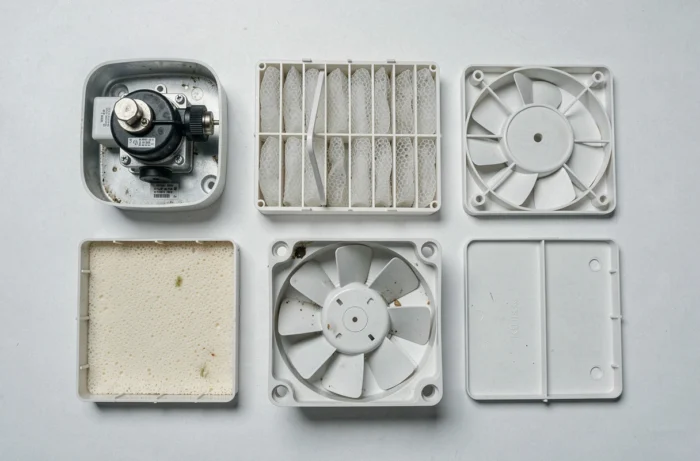
Environmental footprint of the air cooler compared to the air conditioner
The absence of refrigerant gas is the most frequently cited ecological argument. It remains valid: an air cooler contains no greenhouse gas. Its electricity consumption is limited to the fan motor and a small water pump, which is a fraction of what a compressor air conditioner consumes.
The new European environmental performance requirements now compare cooling devices based on grams of CO₂ per final kWh, rather than solely on the presence or absence of refrigerant gas. In this regard, the adiabatic air cooler maintains a clear advantage due to its low electricity consumption.
From a regulatory standpoint, portable coolers sold in France are classified as small electric cooling devices. They must comply with European electrical safety directives (low voltage, electromagnetic compatibility), RoHS requirements on hazardous substances, and be registered under the extended producer responsibility (EPR/WEEE) for the management of electrical equipment waste.
- CE marking is mandatory covering electrical safety and electromagnetic compatibility.
- EPR/WEEE registration for the recycling of household equipment.
- Labeling in French, with mentions compliant with the AGEC law on consumer information.
These obligations, rarely mentioned in product specifications, provide a useful sorting criterion to distinguish a compliant device from an undeclared import.
The air cooler remains a comfort device for occasional use, effective in dry air and a ventilated room, less relevant when ambient humidity rises. Checking the humidity level in the room before each startup gives a reliable indication of the temperature gain that can actually be achieved.