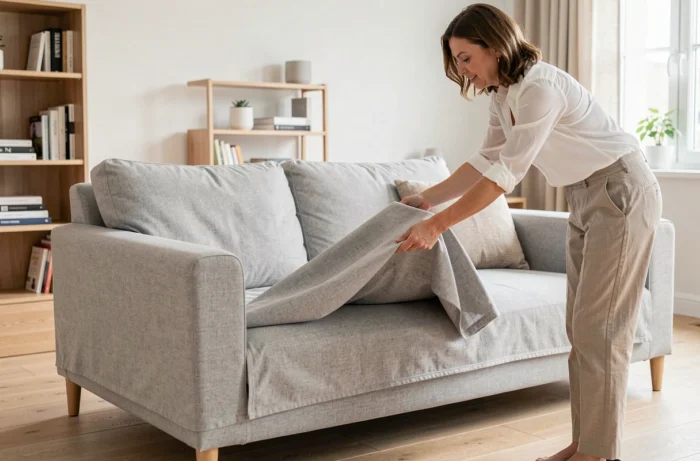
A Conforama sofa that starts to show signs of wear doesn’t necessarily justify a replacement. A well-fitted cover gives it a new look, protects it from stains, and allows you to change styles without investing in new furniture. However, you need to choose the right one: shape, fabric, fastening system, everything matters.
Shape Compatibility: The Trap of Conforama Corner Sofas
Before looking at colors or materials, the first check is the exact shape of the sofa. A straight two-seater model, a click-clack convertible, and a corner sofa do not accept the same type of cover. Buying a universal cover for a corner sofa exposes you to unsightly wrinkles and a fabric that constantly slips.
Conforama corner sofas often have a chaise longue fixed on the left or right. Check the direction of the corner before placing any order: a cover designed for a left corner will not fit a right corner, even if the dimensions seem close. The most reliable method is to measure the total length (including the back), the seat depth, and the back height, then compare these measurements to the manufacturer’s specifications for the cover.
To choose a Conforama sofa cover with a corner correctly, prefer models sold in two separate pieces (one for each section) rather than a single-piece cover. The fit is more precise and the installation significantly simpler.
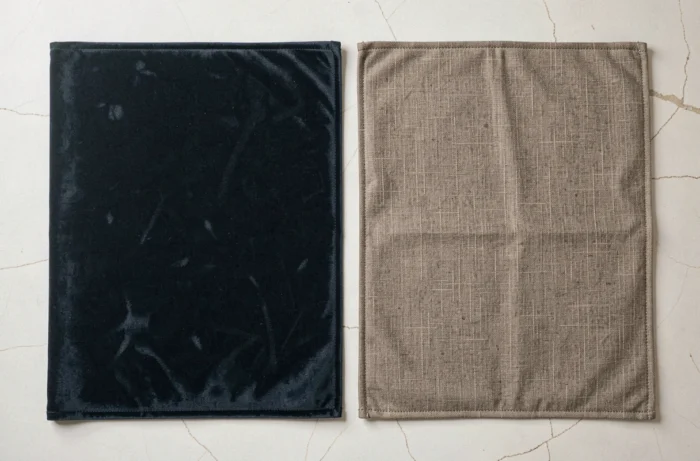
Stretch Fabric or Fitted Fabric: Which Textile for Which Use
The choice of fabric determines both the comfort to the touch, durability, and ease of maintenance. Two main families stand out in the cover market.
Stretch Covers in Elastic Fabric
Stretch covers (often in a polyester-elastane blend or stretch jacquard) conform to the shape of the sofa thanks to their elasticity. They are particularly suitable for sofas with rounded shapes or wide armrests. An elastic fabric compensates for small measurement discrepancies, reducing the risk of error at purchase.
Their limit: a very thin fabric wears out faster, especially if pets scratch the seat. Check the weight. The denser the fabric, the better it will withstand daily friction.
Fitted Covers in Cotton or Blended Linen
These covers offer a more structured drape, close to the original upholstery. They provide a neat finish and are generally machine washable at low temperatures. Cotton breathes better in summer, avoiding the sticky feeling of 100% synthetic materials.
Their drawback: they are less forgiving of size errors. A cotton cover that is too large creates pockets at the corners, and a cover that is too small pulls on the seams. Measurements must be precise to the centimeter.
Fastening and Retention: What Makes the Difference Daily
A cover that slips every hour eventually ends up not being used. The fastening system is a criterion often overlooked, but it determines long-term satisfaction.
- Foam rods (or cords) slide between the seat and the back to secure the fabric in place. This is the most effective system for straight sofas.
- Elastic straps under the seat keep the cover taut from below. They work well on models with raised legs, less so on sofas resting on the floor.
- Adjustment cords at the armrests allow for lateral tension adjustment. Useful on sofas with thin armrests where the fabric tends to ride up.
- Non-slip patches glued under the cover prevent slipping on leather or faux leather seats, which are naturally smooth surfaces.
Combining foam rods and elastic straps offers the most reliable retention. If your Conforama sofa has a slippery covering (faux leather, vinyl), add a non-slip patch under each seat.
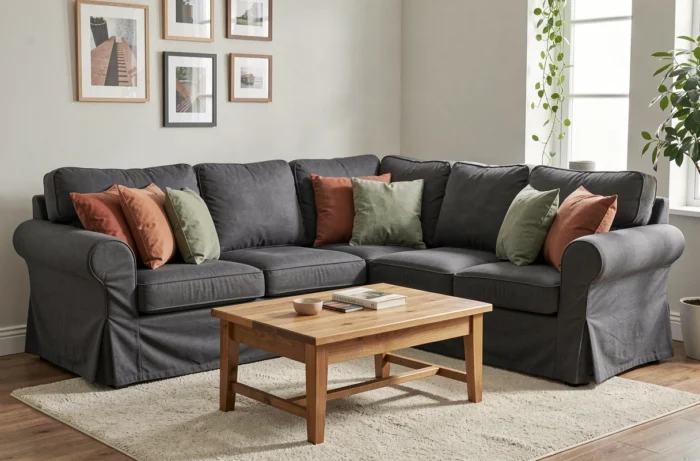
Maintenance and Lifespan of a Sofa Cover
Do you have young children or a cat that considers the sofa its territory? The washing frequency will determine the choice of fabric.
The majority of stretch covers in polyester can be machine washed at 30 or 40 °C. Avoid the dryer, which damages elastic fibers and causes gradual shrinkage. Air drying flat preserves the shape and elasticity of the fabric.
Plan for two covers to alternate during washes. This prevents leaving the sofa bare and extends the lifespan of each cover by reducing the frequency of use.
Some covers benefit from a factory-applied water-repellent stain treatment. This treatment facilitates cleaning surface spills, but it fades over time with washes. A textile waterproofing spray, applied every three to four months, helps maintain this protection.
Sofa Cover and Fire Regulation: A Little-Known Point
If you buy a cover for a sofa installed in a professional setting (waiting room, medical office, nursing home), the question of fire behavior arises. Since decree n°2025-1100 came into effect on July 1, 2026, upholstered furniture used in health environments must meet fire reaction requirements based on Euroclasses EN 13501-1.
The classification must pertain to the final product as used: a sofa equipped with a removable cover must be tested in this configuration. Changing the cover may result in loss of compliance if the new fabric does not offer equivalent fire behavior. Fire reaction reports remain valid for five years and must be issued by accredited laboratories.
For domestic use, this constraint does not apply. However, it is worth knowing for professionals who equip their reception areas with Conforama sofas covered with covers.
The choice of a sofa cover relies on three concrete checks: shape compatibility (especially for corners), the type of fabric suited to your lifestyle, and a fastening system that truly stays in place. A cover costing 30 euros that slips every day is more expensive than a 60-euro cover that stays in place for two years.