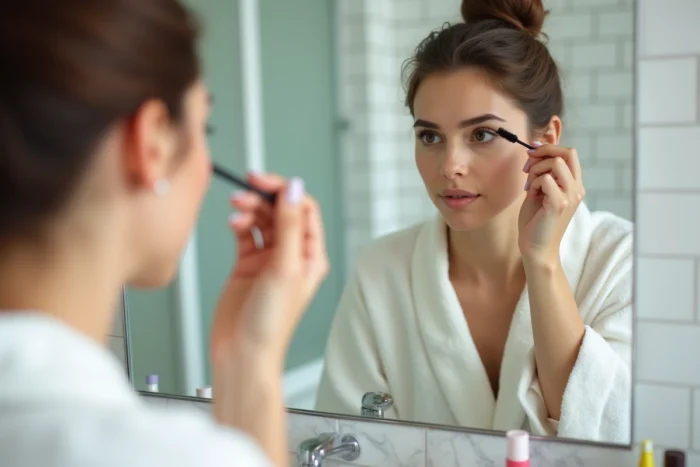
The term “ricil” often comes up in beauty conversations, sometimes confused with classic mascara. Behind this word is actually castor oil, a plant-based treatment applied to the lashes to strengthen them. Mascara, on the other hand, remains a makeup product designed to color and thicken the lash fringe. Comparing these two products is like opposing two distinct logics: daily care on one side, immediate visual effect on the other.
Castor oil on lashes: a misunderstood treatment and not without risk
Castor oil (often abbreviated as “ricil” in everyday language) is extracted from the seeds of the common castor plant. It is rich in ricinoleic acid, a fatty acid that coats the lash fiber and limits breakage. Applied in the evening with a clean brush, it can give the lashes a denser appearance after several weeks of regular use.
The confusion begins when it is presented as a substitute for mascara. Castor oil does not color the lashes and does not change their curl. Its role is limited to care: nourishing, coating, protecting. Expecting it to perform in the realm of makeup is to mistake the product.
A point rarely addressed in beauty guides concerns the purity of the oil used. The castor seed naturally contains ricin, a toxin that is removed during the refining process. Poorly refined or questionable quality oil, applied near the eye, can cause blepharitis (inflammation of the eyelids) and blockage of the sebaceous glands. This risk particularly affects “raw” oils purchased without cosmetic control, used in DIY applications without quality filtering.
For those who wish to choose between ricil or mascara, this distinction between care and makeup constitutes the first decision-making criterion: the desired result is simply not the same.
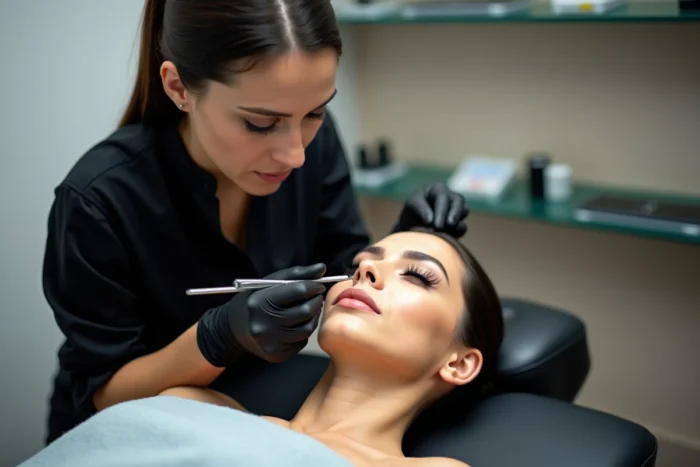
Mascara and composition: how the formula changes daily
Mascara affects three visual parameters: color, volume, and apparent length of the lashes. The formula (waxes, pigments, film-forming polymers) determines the hold and final result. The brush, depending on its shape and the density of its fibers, directs the effect obtained towards more curl or more thickness.
Formulas have evolved in recent years towards so-called “hybrid” mascaras, incorporating care actives directly into the tube. Some contain castor oil, peptides, or keratin, with the ambition to provide makeup while strengthening the lash.
This category blurs the line between care and makeup, but feedback from the field diverges: the care effect remains modest compared to pure oil applied alone, as the concentration of active ingredients is diluted in the mascara matrix.
Ingredients to watch in a mascara
Vigilance focuses on several families of ingredients:
- Formaldehyde-releasing preservatives, still present in some low-cost formulas, which can irritate the sensitive eye area.
- Synthetic fragrances, rarely useful in a mascara and potentially allergenic with prolonged contact with the eyelid.
- Carbon black nanoparticles, used as black pigment, whose toxicological profile is still under discussion at the European regulatory level.
Choosing a certified organic mascara or one formulated in clean beauty reduces exposure to these substances, without completely eliminating it. Reading the INCI list remains the most reliable gesture before purchase.
Ricil in the evening, mascara in the morning: combine rather than choose
Opposing ricil and mascara often poses a false dilemma. The two products occupy different time slots and functions. Castor oil is applied in the evening on makeup-free lashes, in a treatment lasting several weeks. Mascara is applied in the morning for an immediate effect, removed at the end of the day.
This complementarity works as long as a few simple rules are followed:
- Use a cosmetic-grade castor oil (with “ocular use” or “eye contour” mention), never a food or industrial oil.
- Clean the application brush for ricil after each use to avoid bacterial contamination.
- Space the application of the oil and the application of mascara by at least eight hours, to allow the oily film to absorb and not compromise the adhesion of the mascara.
- Thoroughly remove mascara before applying the oil, as wax and pigment residues prevent the oil from penetrating the fiber.
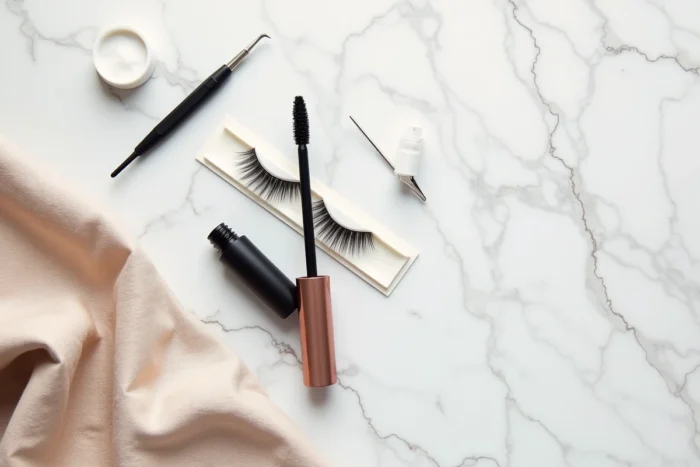
Mascaras brush and lash type: a often overlooked parameter
The brush influences the result at least as much as the formula. A conical brush concentrates the product on the outer lashes and enhances the “doe-eyed” effect. A ball or small diameter brush catches the short lashes in the inner corners, often overlooked by standard brushes.
Fine and straight lashes benefit more from a curved brush with short and dense fibers, which keeps the lash elevated while the formula dries. Naturally long and full lashes handle a wide brush with spaced fibers better, which deposits less product and avoids the “clumpy” effect.
The choice of brush is not as clearly indicated on the packaging as the ingredient list. Observing the shape through transparent packaging (when available) or relying on detailed photos remains the most direct way to assess compatibility with one’s lash fringe.
When mascara is no longer enough
Some people find that neither ricil nor mascara produce the desired effect, especially in cases of very sparse lashes after medical treatment or lash alopecia. Peptide-based serums represent a third option, positioned between the passive care of castor oil and the camouflage of mascara.
Their effectiveness varies depending on the formulations, and the available data do not allow for a uniform conclusion about their superiority over pure castor oil.
Ultimately, the choice between ricil and mascara depends less on the product itself than on what one expects from their lashes: a visible result in seconds, or gradual strengthening over several weeks. Both approaches coexist without competing, as long as one does not ask one to provide what only the other can offer.