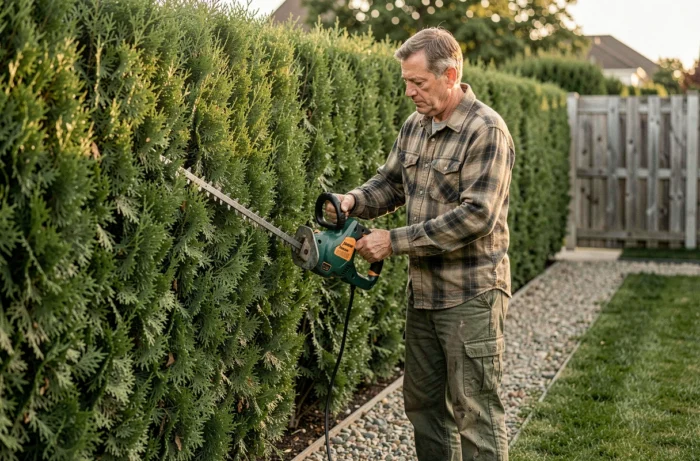
A thuja left untrimmed for two seasons eventually widens at the base, becomes sparse in the center, and spills over into the neighboring yard. Recovering a hedge in this state is often impossible because the thuja does not regrow on old wood.
Knowing when and how deeply to prune determines the lifespan of the hedge as much as its appearance. This guide outlines the concrete actions, reliable periods, and limits not to exceed to maintain a dense thuja hedge year after year.
Old wood and regrowth: the constraint that governs everything else
Most pruning mistakes on thujas stem from a lack of understanding of their physiology. Unlike a laurel or a hornbeam, the thuja does not generate new buds on old wood. If you cut beyond the green zone, into the brown and woody part, the gap will remain visible for years, sometimes permanently.
In practical terms, this means that you always work within the thickness of the green foliage, never reaching the bare wood. On a well-maintained hedge, this green margin is a few centimeters. On a neglected hedge, it may shrink to almost nothing, drastically limiting the possible correction.
Before taking out the hedge trimmer, spread the surface branches to check where the brown wood begins. If the green area is very thin, it’s better to settle for a light refresh rather than trying to reduce the width. When wondering how to prune a thuja hedge without disfiguring it, this prior inspection makes the difference between a clean result and a gappy hedge.
Pruning period for thujas: two windows, no more
It is sometimes said that thujas should be pruned “regularly.” In practice, two sessions per year are sufficient and correspond to the times when the plant recovers best.
Late spring: formative pruning
The first window occurs after the spring growth, generally in May or early June. At this stage, the new shoots are sufficiently developed to be shortened without touching the old wood. This is the pruning that shapes the hedge for summer.
Late summer: finishing pruning
The second session takes place between late August and mid-September. Growth slows down, and the hedge maintains its clean profile until the following spring. Pruning after October exposes the cuts to frost and weakens the tips before winter.
Nesting: a schedule to respect
Environmental authorities recommend avoiding significant hedge pruning between March and the end of July to avoid disturbing nesting birds. You can reconcile both constraints by scheduling formative pruning at the end of May (after the peak nesting of the earliest species) and finishing pruning in September. A quick look into the hedge before intervening allows you to spot an active nest and postpone the operation by a few weeks if necessary.
Cutting technique for a regular thuja hedge
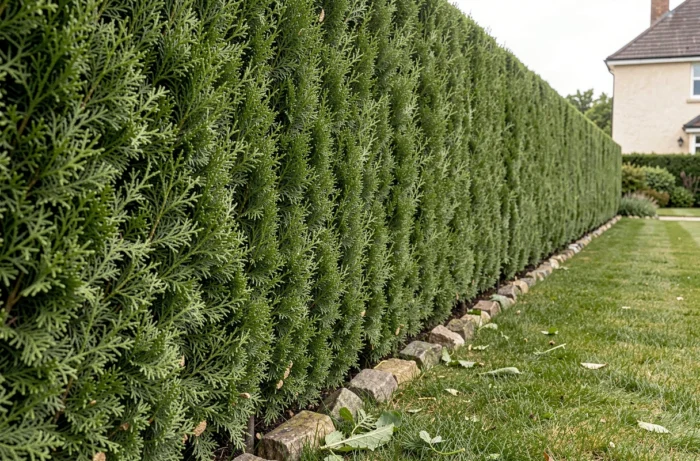
A trapezoidal profile, wider at the base than at the top, remains the most effective shape for thuja hedges. This geometry ensures that light reaches the bottom of the hedge, keeping the foliage dense down to the ground.
To achieve a straight result along the entire length, stretch a line between two stakes at the desired cutting height. Without this reference, you will inevitably create waves, and irregularities are more noticeable on a conifer than on deciduous foliage.
- Start with the sides, working from the bottom up, with the blade slightly angled inward to create the trapezoidal profile
- Then move to the top, following the line, keeping the blade perfectly horizontal
- Finish with a clearance at the base: remove dead branches and accumulated debris at the foot to promote air circulation
- Immediately collect the pruning waste, which acidifies the soil if left in place
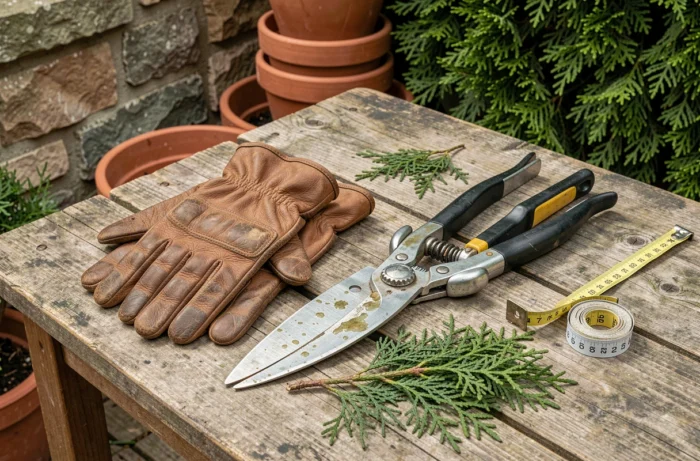
A hedge trimmer with a blade of at least 60 cm gives better results on thujas than a compact model, as it allows for long and even passes. For thicker branches that exceed the profile, a lopper or pole pruner prevents forcing the blade and leaving torn cuts.
Hedge height and legal risk: what the law requires
Regulations on hedge height depend on the planting distance from the property line. Within two meters of the fence, the hedge must not exceed two meters in height. Beyond two meters, no height limit generally applies.
Since 2024, Article 1253 of the Civil Code establishes liability in cases of disturbance exceeding the normal inconveniences of neighborhood life. A hedge that is too tall can now be targeted even if planting distances are respected, as long as it causes a loss of sunlight, a lasting shadow, or an obstructed view for the neighbor.
In practice, keeping your thuja hedge at a reasonable height (around two meters) avoids most disputes. You still encounter thuja hedges reaching over four meters in some developments. Reducing them to two meters all at once is almost never possible without reaching the old wood. The only viable option is to gradually reduce the height over several seasons, removing the maximum amount that remains in the green zone each time.
Maintenance between prunings: keeping the hedge healthy
Pruning alone is not enough. A thuja that turns yellow or brown between sessions indicates a root problem, lack of water, or overly compacted soil.
- Deep watering during dry periods, especially in the first two years after planting, limits summer browning
- A spring application of fertilizer for conifers supports the growth of green foliage, the very part that will be pruned
- Mulching at the base of the hedge retains moisture and limits competition from weeds
Thuja pruning waste decomposes poorly due to its acidity and resin content. Shredding them before taking them to the dump or a composting site speeds up their decomposition. Leaving them piled at the foot of the hedge eventually suffocates the surface roots.
A well-maintained thuja hedge ultimately requires little time: two interventions per year, a line, a proper hedge trimmer, and the habit of checking the green margin before each cut. The thuja forgives routine but not improvisation.