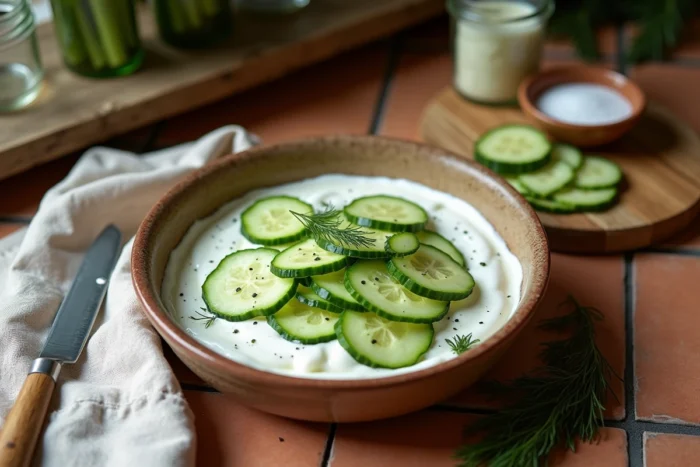
Cucumber with cream presents a problem that most recipes overlook: it’s not the cream that fails, it’s the water from the cucumber that dilutes everything. You take the bowl out of the refrigerator, and the sauce has turned into a whitish juice. However, cucumber with cream remains a French starter that deserves better than this watery fate, provided you understand a few simple mechanisms that the basic recipe never mentions.
Draining the cucumber: fine salt, duration, and common mistakes
You salt the slices, wait, and drain. The action seems basic, but the duration and method change everything. If it’s too short, the cucumber still releases water after seasoning. If it’s too long, it becomes soft and loses its crunch, which is the only reason to serve it raw.
The sweet spot in real kitchen practice is around fifteen to twenty minutes, no more. You lay the slices in a single layer on a clean towel, sprinkle with fine salt (not coarse salt, which acts too slowly), then press firmly in the towel before incorporating the sauce.
The most common mistake is draining in a colander without drying afterward. The cucumber then retains a film of water on the surface that dilutes the cream as soon as it’s mixed. Drying after draining radically changes the consistency of the sauce.
To better understand the origin of cucumber with cream on La Cuisine de Watoote, it quickly becomes clear that this starter has traversed decades without much evolution in its basic technique, while the available dairy products have significantly diversified.

Crème fraîche, Greek yogurt, or skyr: which base to choose for the sauce
Thick crème fraîche remains the classic choice. It provides body, a roundness in the mouth, and holds well in the refrigerator. The problem is that it masks the taste of the cucumber if used too generously.
In recent years, the French health-food press has been pushing for lighter alternatives. Top Santé and Ouest-France highlight plain yogurt, Greek yogurt, or skyr as direct substitutes for crème fraîche in summer starters, with the argument of reducing saturated fats.
In practice, Greek yogurt offers the best compromise: thick enough not to run, neutral enough to allow the acidity of lemon or vinegar to shine through. Skyr, being higher in protein, gives a slightly grainy texture that not everyone enjoys. Feedback on this point varies by brand.
Balancing acidity without overpowering the cucumber
The trio of fat-acidity-herbs structures the sauce. You add a teaspoon of white wine vinegar or fresh lemon juice to enhance, not to overly acidify. The acidity should remain in the background, never dominate.
Dill and chives are the most common herbs. Dill adds an aniseed note that pairs well with dairy bases. Chives, being more subtle, are better when you want the cucumber to remain the star.
Cucumber with cream and an anti-waste approach: also cooking the peels
You peel the cucumber out of habit, often without reason. The skin is edible, rich in fiber, and adds a slight bitterness that can enhance the dish instead of impoverishing it. Culinary blogs committed to a zero-waste approach have recently proposed creams or gazpachos made from blended cucumber peels with plant-based yogurt or skyr.
This is not a gimmick. Blending the peels with the creamy base, a drizzle of lemon, and a few mint leaves produces a cold velouté served in a glass as an appetizer. You make use of what would have been discarded, and you achieve a denser texture than cucumber alone.
- Washed and blended peels with Greek yogurt: base for a raw green gazpacho, ready in five minutes.
- Peels cut into thin strips and added raw to the bowl: extra crunch and a more vibrant color.
- Peels infused in apple cider vinegar for an hour: a tangy condiment to use as a seasoning for the sauce.
Nutritional value of cucumber with cream: where the fat really hides
The cucumber itself contains virtually no fat. The caloric load of a bowl of cucumber with cream comes almost exclusively from the sauce. This is a point that recent nutritional labels clearly emphasize.
Lightening the sauce halves or even reduces the caloric intake of the dish by two or three times without affecting the volume or the feeling of satiety. Replacing crème fraîche with plain yogurt changes the perceived texture little, especially if you add a pinch of salt and a splash of lemon to compensate for the loss of roundness.
Comparison table of creamy bases
| Base | Texture | Refrigerator stability | Profile |
|---|---|---|---|
| Thick crème fraîche | Creamy, dense | Good (several hours) | Rich, round |
| Greek yogurt | Thick, smooth | Good | Lighter, slightly acidic |
| Skyr | Firm, slightly grainy | Very good | Protein-rich, neutral |
| Plain classic yogurt | Fluid | Average (releases water) | Light, acidic |
Serving cucumber with cream at the right time
You mix the sauce and cucumber just before serving, ideally less than thirty minutes beforehand. The longer you wait, the more the vegetable releases water, even after careful draining. Assembling at the last moment preserves the crunch and the consistency of the sauce.
For an appetizer, you can cut the cucumber into thick sticks and serve the sauce separately in a small bowl. The cucumber stays dry and crunchy, and each guest can serve themselves as they wish. This presentation also avoids the issue of the bowl turning into juice after an hour on the table.
- As an individual starter: thin slices, sauce poured in the center, fresh herbs on top.
- As an appetizer: sticks with dipping sauce, more practical and visually cleaner.
- In a glass: alternating layers of cucumber cut into small cubes and sauce, for a neat visual effect without effort.
Cucumber with cream doesn’t need a spectacular reinvention. It mainly requires rigor on two specific points: mastering the cucumber’s water and choosing the right creamy base. The rest, herbs, acidity, cutting, can be adjusted based on what you have on hand and the serving format. A starter that relies on just a vegetable and a sauce cannot afford approximation.