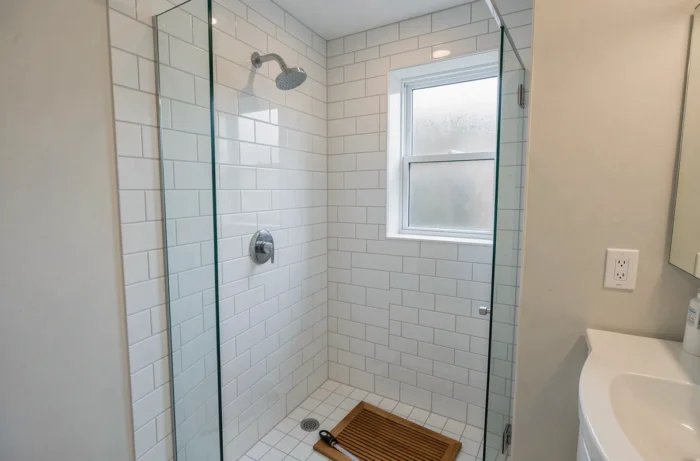
The shower remains the most scrutinized sanitary equipment during a rental visit. However, no French regulation sets minimum dimensions for a shower tray in rental housing. The decency decree requires functional sanitary equipment with hot water supply but says nothing about the size of the tray. This ambiguity leaves landlords and tenants facing expectations that are sometimes very far from the reality of the existing housing stock.
The 80×80 cm tray: the real market floor threshold for rentals
Specialized content and field feedback converge on a single benchmark: 80×80 cm is the minimum accepted in rentals. Below this, particularly at 70×70 cm, the shower is perceived as a last resort solution reserved for extreme configurations, typically converted service rooms or micro-studios.
This threshold of 80 cm per side has no regulatory basis. It has established itself through use, as it corresponds to the smallest footprint in which an average-sized adult can wash without hitting the walls. Manufacturers of trays and integrated cabins offer very few models below this size, which mechanically limits the supply for landlords.
To delve deeper into this point, the standard shower size according to Cherry Déco details common formats and their alignment with current rental expectations.
A landlord who installs a 70×70 cm tray in a T2 apartment takes a concrete risk: prospective tenants compare, and a shower deemed too narrow can be enough to rule out a property in favor of a competing apartment that is better equipped, even if slightly more expensive.
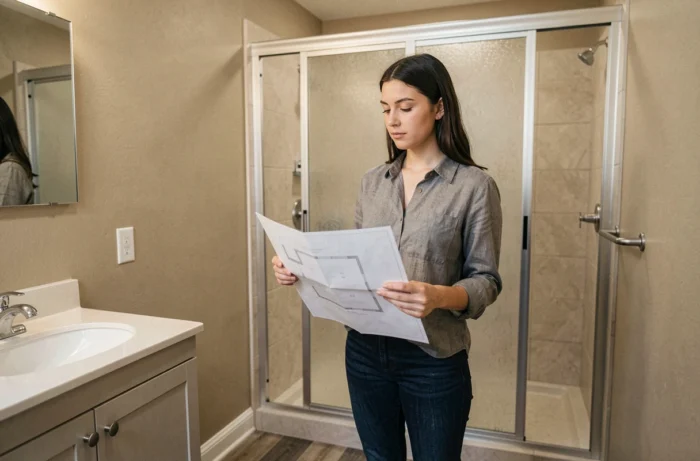
Standard shower dimensions: the 90×90 cm as the sought-after compromise
The format 90×90 cm emerges as the best compromise between footprint and daily comfort. In content that discusses actual use rather than technical compliance, this dimension is most often associated with the word “standard”.
The difference with an 80×80 cm seems modest on paper, but it is felt in use. An additional ten centimeters on each side changes the freedom of movement, ease of cleaning, and overall perception of the bathroom. For a landlord, moving from 80 to 90 cm represents a limited additional cost for the tray itself, with most of the budget being absorbed by installation and plumbing.
Square or rectangular format
The choice mainly depends on the room configuration. In a long bathroom (a common case in rentals), a rectangular tray of 120×80 cm sometimes fits better than a square one. The 120×80 and 120×90 cm formats are gaining ground as soon as the bathroom area allows, particularly in apartments aiming for an Italian-style shower.
Tenants increasingly associate the rectangular shower with a renovated and well-thought-out apartment. This format sends a signal of comfort that can justify a slightly higher rent positioning.
Landlord obligations: decency and sanitary equipment
The legal framework does not mention centimeters. The decree of January 30, 2002, regarding decency criteria requires a potable water supply, wastewater drainage, a kitchen area, and indoor sanitary equipment with hot water. A functional shower fulfills this obligation just like a bathtub.
No minimum shower surface is imposed. A landlord can technically install a 70×70 cm tray and remain within regulatory bounds, provided that everything functions correctly (waterproofing, drainage, ventilation). Field feedback varies on this point: some tenants consider a shower too cramped to be indecent, but courts have not established clear case law on a minimum dimension.
- The landlord must provide sanitary equipment allowing for washing, with hot and cold water, but the law does not specify the size of the tray.
- Regular maintenance of the shower (seals, showerhead, hose) is the tenant’s responsibility. The replacement of the tray or outdated fixtures remains the landlord’s responsibility.
- In case of replacement, the landlord has no obligation to enlarge the existing shower, even if market standards have evolved.
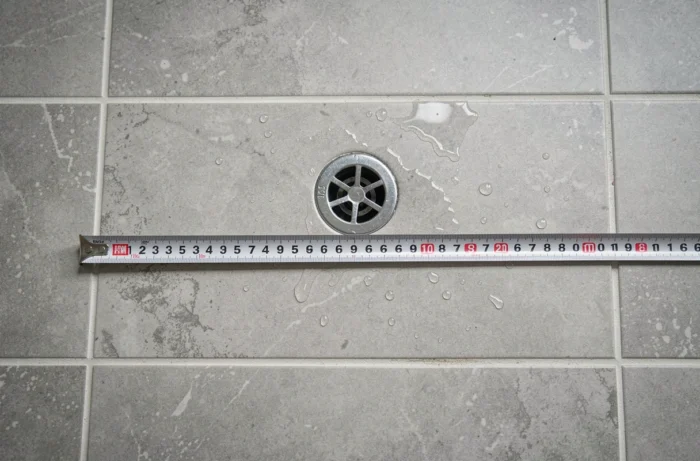
Accessibility for people with reduced mobility and showers in rentals: a growing criterion
Dimensional benchmarks change radically when discussing accessibility. For a PMR shower, the reference is at least 90×120 cm, with level access without a threshold greater than 2 cm. These standards apply mandatorily in new collective housing since the accessibility regulations but not in the older private rental stock.
A senior tenant or someone with reduced mobility can request permission from the landlord to adapt the bathroom. The request is made by registered letter with acknowledgment of receipt. If there is no response from the landlord within two months, the agreement is deemed acquired according to Article 7 of the law of July 6, 1989. Assistance such as MaPrimeAdapt’ can fund part of the work.
This topic is still treated from a regulatory perspective and housing adaptation. It is not yet part of common rental expectations, but demand is increasing as the population ages and tenants compare services between apartments.
What the comfort of a rental shower depends on beyond dimensions
Reducing comfort to just the surface area of the tray would be a mistake. Several parameters influence the tenant’s perception as much, if not more, than the centimeters:
- The height of the showerhead and the quality of the fixtures, which condition the daily experience far more than the width of the tray.
- The presence or absence of a fixed wall or curtain: a glass wall on an 80 cm tray gives a greater sense of space than a curtain on a 90 cm tray.
- The circulation space in front of the shower, often overlooked. A spacious tray in a bathroom where one cannot dry off properly loses much of its appeal.
- The ventilation and flooring, which determine whether the room remains healthy or if humidity quickly degrades the equipment.
A landlord renovating a bathroom gains more by investing in all these areas rather than just the size of the tray. An 80 cm well-equipped tray performs better than a 120 cm in a poorly ventilated bathroom.
The available data do not allow for a conclusion on a single format that would suit all tenant profiles. The 90×90 cm remains the most solid benchmark for a standard apartment, but satisfaction depends on a balance between surface area, equipment, and overall room layout.